
The Living-Green Myth: The Promise and Limits of Lifestyle Environmentalism
.jpg)
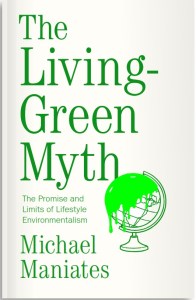 Michael Maniates
Polity Press, Wiley, Amazon.com, Fall 2025
The claim that we help save the world by living green and persuading others to do the same is a myth that benefits powerful interests while imperiling the planet and future generations. To be sure, small acts of environmental stewardship are important for the community they build and the ethical resonance they offer. But making a difference won’t happen by riding a bike, eating less meat, recycling more diligently, or buying “green” products. There are better, more rewarding strategies that foster creativity and honor our affections for buying green and living lean.
Consumption Corridors: Living a Good Life Within Sustainable Limits
Doris Fuchs , Marlyne Sahakian, Tobias Gumbert, Antonietta Di Giulio, Michael Maniates, Sylvia Lorek, Antonia Graf
Routledge Press, 2021. Open access, free to download.
Consumption Corridors: Living a Good Life within Sustainable Limits explores how to enhance peoples’ chances to live a good life in a world of ecological and social limits.
Rejecting familiar recitations of problems of ecological decline and planetary boundaries, this compact book instead offers a spirited explication of what everyone desires: a good life. Fundamental concepts of the good life are explained and explored, as are forces that threaten the good life for all. The remedy, says the book’s seven international authors, lies with the concept of consumption corridors, enabled by mechanisms of citizen engagement and deliberative democracy.
Across five concise chapters, readers are invited into conversation about how wellbeing can be enriched by social change that joins “needs satisfaction” with consumerist restraint, social justice, and environmental sustainability. In this endeavour, lower limits of consumption that ensure minimal needs satisfaction for all are important, and enjoy ample precedent. But upper limits to consumption, argue the authors, are equally essential, and attainable, especially in those domains where limits enhance rather than undermine essential freedoms.
Global Socio-Economic Perspectives

Terrence Bensel, Lisa Dale, and Michael Maniates (co-authors listed in alphabetical order)
Bridgepoint Education/Kendall Hunt Publishing, 2012
Global Socio-Economic Perspectives, specifically conceived and executed as an e-book with an array of online resources and simulations, examines historical forces behind current social, political, economic, and environmental conditions, and seeks solutions for achieving a just and sustainable world. Focus on issues of globalization, economic and social justice, and sustainability contextualizes opportunities and challenges presented by globalization, as well as winners and losers in different regions. Go here for the opening paragraphs.
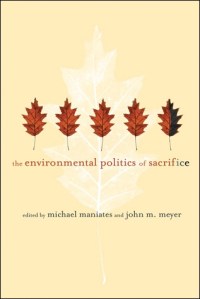
The Environmental Politics of Sacrifice
Michael Maniates and John M. Meyer, editors
MIT Press, 2010
The idea of sacrifice is the unspoken issue of environmental politics. Politicians, the media, and many environmentalists assume that well-off populations won’t make sacrifices now for future environmental benefits and won’t change their patterns and perceptions of consumption to make ecological room for the world’s three billion or so poor eager to improve their standard of living. The Environmental Politics of Sacrifice challenges these assumptions, arguing that they limit our policy options, weaken our ability to imagine bold action for change, and blind us to the ways sacrifice already figures in everyday life.
The concept of sacrifice has been curiously unexamined in both activist and academic conversations about environmental politics, and this book is the first to confront it directly. The chapters bring a variety of disciplinary perspectives to the topic. Contributors offer alternatives to the conventional wisdom on sacrifice; identify connections between sacrifice and human fulfillment in everyday life, finding such concrete examples as parents’ sacrifices in raising children, religious practice, artists’ pursuit of their art, and soldiers and policemen who risk their lives to do their jobs; and examine particular policies and practices that shape our understanding of environmental problems, including the carbon tax, incentives for cyclists, and the perils of green consumption. The Environmental Politics of Sacrifice puts “sacrifice” firmly into the conversation about effective environmental politics and policies, insisting that activists and scholars do more than change the subject when the idea is introduced.
Contributors: Peter Cannavò, Shane Gunster, Cheryl Hall, Karen Litfin, Michael Maniates, John M. Meyer, Simon Nicholson, Anna Peterson, Thomas Princen, Sudhir Chella Rajan, Paul Wapner, Justin Williams
Encountering Global Environmental Politics
Michael Maniates, editor
Rowman & Littlefield, 2003
Recognizing that many undergraduate courses on global environmental ills, though well intentioned, erode students’ sense of the possible, this collection of essays (all by teacher-scholars in the field) draws students and teachers of global environmental politics into classroom conversation about the overwhelming nature of global environmental threats, the tenuous and sometimes counterproductive links between knowledge and power, and ways of acting powerfully in the world in service of ‘sustainability.’
Foreword by Frances Moore Lappé
Contributors: Matthew Auer, William Ayers, Ken Conca, Geoffrey Dabelko, Barbara Welling Hall, Monty Hempel, Michael Maniates, Richard Matthew, Tom Princen, Nancy Quirk, Karl Steyaert, Peter Taylor, Paul Wapner, and Howard Warshawsky
Confronting Consumption
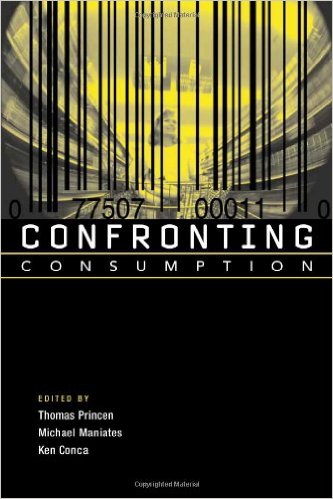
Thomas Princen, Michael Maniates, and Ken Conca, editors
MIT Press, 2002
Comforting terms such as “sustainable development” and “green production” frame environmental debate by stressing technology (not green enough), economic growth (not enough in the right places), and population (too large). Concern about consumption emerges, if at all, in benign ways; as calls for green purchasing or more recycling, or for small changes in production processes. Many academics, policymakers, and journalists, in fact, accept the economists’ view of consumption as nothing less than the purpose of the economy. Yet many people have a troubled, intuitive understanding that tinkering at the margins of production and purchasing will not put society on an ecologically and socially sustainable path.
Confronting Consumption places consumption at the center of debate by conceptualizing “the consumption problem” and documenting diverse efforts to confront it. In Part 1, the book frames consumption as a problem of political and ecological economy, emphasizing core concepts of individualization and commoditization. Part 2 develops the idea of distancing and examines transnational chains of consumption in the context of economic globalization. Part 3 describes citizen action through local currencies, home power, voluntary simplicity, “ad-busting,” and product certification. Together, the chapters propose “cautious consuming” and “better producing” as an activist and policy response to environmental problems. The book concludes that confronting consumption must become a driving focus of contemporary environmental scholarship and activism.
 Michael Maniates